





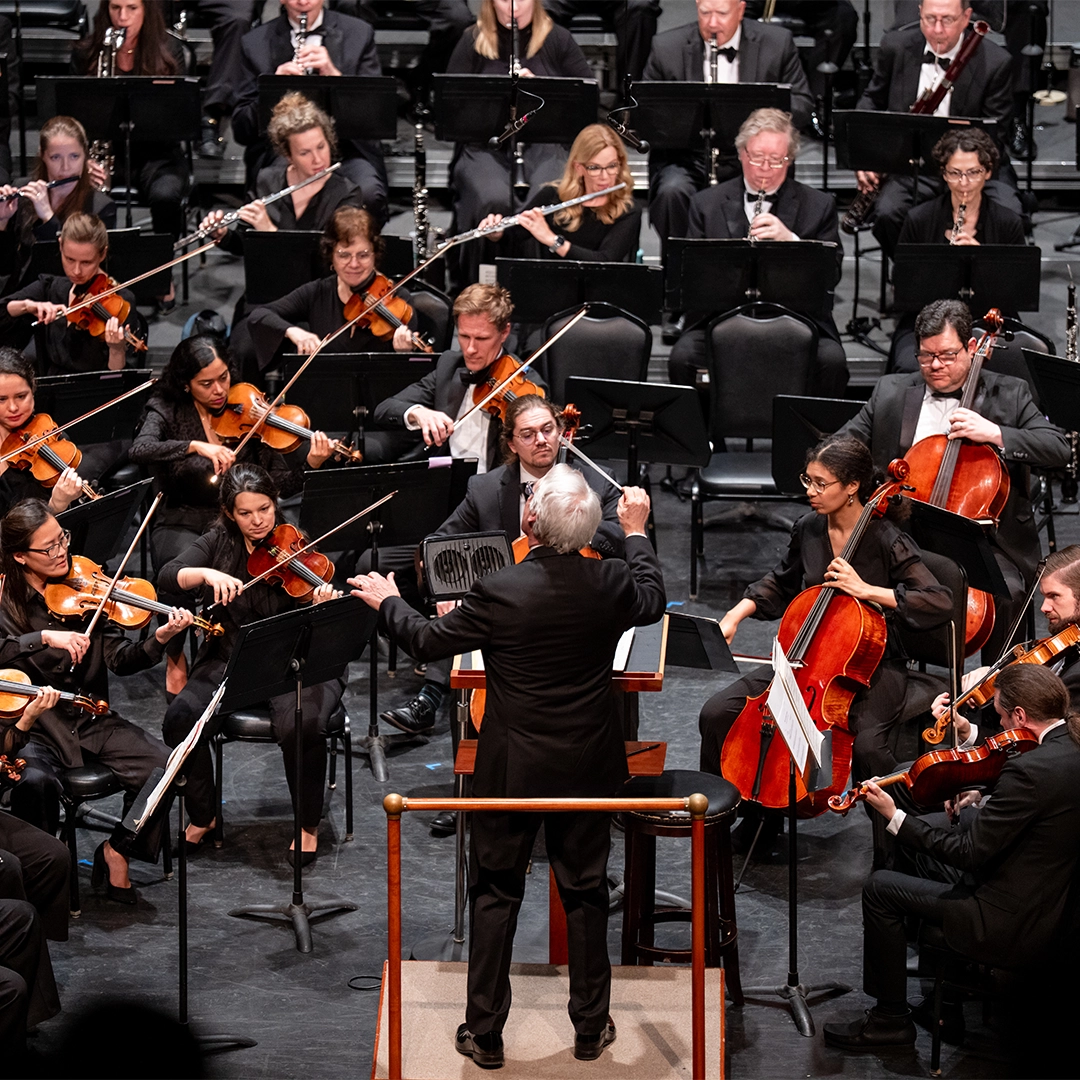
Classical music will take center stage at this year’s Foo Foo Festival when the Pensacola Symphony Orchestra brings Mozart & Bizet to the Saenger Theater on November 7.
Featuring Music Director Peter Rubardt and internationally acclaimed pianist Carter Johnson, the program brings together works by Igor Stravinsky, Wolfgang Amadeus Mozart, and Georges Bizet for an evening that moves from Baroque-inspired modernism to one of Mozart’s most dramatic piano concertos and a symphony written by Bizet when he was just 17.
The performance, part of the Pensacola Symphony Orchestra’s grant-funded Foo Foo programming, is a chance for the orchestra to step outside its regular season and be part of the broader artistic conversation happening across Pensacola. For Music Director Peter Rubardt, that opportunity made it possible to build a program around three significant pieces that each have their own story to tell.
At the heart of the program is Mozart’s Piano Concerto No. 24 in C minor. “It’s a large-scale, gorgeous piece,” Rubardt says. “I’ve done this piece several times, and it’s always a spectacular piece for the audience.”
Of Mozart’s 27 piano concertos, only two were written in minor keys. Piano Concerto No. 24 is one of them, giving the work a darker, more dramatic character than many of Mozart’s other concertos. “Minor-key Mozart is just a very special world,” Rubardt says. “Any chance you have to get into that world, the richness of the harmonies, the shaping of the lines, he goes to a special place when he writes in a minor key.”
The evening opens with Igor Stravinsky’s Pulcinella Suite, a work that reaches back into the Baroque era while sounding like the 20th century. Stravinsky wrote Pulcinella after being commissioned to create a ballet using music by Italian Baroque composer Giovanni Battista Pergolesi. But what began as an arrangement became something much more unique: Stravinsky was drawn to Pergolesi’s music and began reshaping it, blending the older compositions with his own modern musical language. “He didn’t just arrange it,” Rubardt says. “He changed it in subtle and brilliant ways and created a piece of music that’s almost half him and half Pergolesi.”
The result became an important example of neoclassicism, an early 20th-century movement in which composers looked to earlier musical traditions and reinterpreted them through a contemporary lens. For audiences, it also provides an energetic opening to the program. “It’s charming, it’s surprising, it’s joyful, and it’s filled with marvelous moments,” Rubardt says. “Every time you turn around you get caught by surprise with something in the piece.”
That idea of looking to the past and making something new connects Pulcinella with the program’s final work, Georges Bizet’s Symphony in C. Best known for Carmen, Bizet began studying at the Paris Conservatoire when he was just nine years old and wrote Symphony in C at 17—historians believe it was likely an assignment from his composition teacher and then forgotten about. The piece wasn’t discovered until nearly 80 years later and has since become a staple of the orchestral repertoire.
For Rubardt, the connection between Stravinsky and Bizet helped bring the program together as both composers were responding to a specific musical challenge. “They were both written by composers who had a certain specific thing they were trying to do, and they went off and did it,” Rubardt says.
That sense of discovery is part of what makes the program particularly suited to Foo Foo Festival. While the music spans centuries and comes from very different musical worlds, each piece offers audiences a chance to hear how composers can take an existing tradition and make it their own.
Rubardt also hopes the setting and program will make classical music feel less intimidating to those who may not regularly attend symphony concerts. “I think a lot of people when they think about the symphony are a little intimidated because it’s a deep, and in many ways, a mysterious world,” he says. “You don’t need to know anything about classical music to enjoy the symphony. You absolutely do not.”
The most important thing, Rubardt says, is simply being willing to listen. “You don’t have to know anything, you just have to go with an open heart,” he says. “Not even an open mind. Just an open heart; that’s all you need.”
Individual concert tickets go on sale now at PensacolaSymphony.com, by phone at 850.435.2533, or in-person at the Pensacola Symphony Orchestra Office.